Trauma isn't defined by the event but by what happened inside of you when you went through an experience.
The clinical understanding shifted significantly over the past 2 decades.
We now know that trauma is a nervous system response to an experience that felt overwhelming, inescapable, or too much to process at the time. 2 people can go through the same event and come out differently. It will indeed depend on the resources their nervous system had available: a mix of layers of prior experiences, support, biology.
The question isn't whether what happened to you was bad enough. It's whether your nervous system got stuck processing it.
And a traumatized nervous system can also looks like this:
Over sensitivity to sounds that don't bother anyone else.
Scanning every new entered room.
A hard time trusting people, no matter how many times they prove they're safe.
Reactions that feel bigger than the situation seems to present (flooded, shut down, disconnected)
Tension in shoulders, jaw, gut even when trying to relax.
None of that obviously looks like trauma, right? However, this can be symptoms of it.
The hidden signs behind trauma
The more visible symptoms like nightmares, flashbacks, full dissociation usually a lot of attention. But many people live for years with subtler responses that are never aknowledge.
Chronic hypervigilance
Exhausted before the day starts because your nervous system never fully went offline overnight busy replaying the day, scanning every facial expression, tone shifts, delay in text replies...
Closeness that trips a wire.
Wanting connection and pulling back from it. Part of you learned that people who were supposed to be safe, weren't. So intimacy activates something you can't always explain.
Emotional flooding.
Reactions that feel disproportionate. Rage, judgment shutdown, tears that appear out of nowhere. The body unconsciously catalogued a threat. It just got activated again.
Physical symptoms without a clear cause.
Tension headaches, digestive issues, the body carrying the weight of what the mind has learned to manage around.
Memory that feels compressed or flat.
Certain periods of your life feel blurry, emotionally drained of colour. The mind creating distance from what it couldn't fully process at the time.
--------
These don't look like trauma. They look and are recognized by society like personality traits, anxiety, sensitivity. That's exactly why they go unrecognised for so long.
What all of this mean
Recognising these patterns in yourself is not a diagnosis.
It means you had experiences that were hard, and your system did what it was built to do. It tried to keep you safe.
The body tells the truth way before the brain can make sense of it.
If you recognize yourself here, start with curiosity, try to avoid fast conclusions. The reactivity, the guardedness, the chronic tension, these often make complete sense once you understand what's underneath them. And they were solutions, once.
And if they're getting in the way of how you want to live now, that's worth bringing to someone trained to work with exactly this.
A trauma-specialised therapist doesn't only work with abuse survivors and catastrophes. They work with nervous system patterns that formed around any experience that was too much too fast.
---
This article was informed by my notes from the Psychotraumatology Practitioner Training (EFPP) and the sources listed below. AI was used as a writing and editing assistant, while all content was reviewed and curated by me.
Journal of Traumatic Stress - Hyperarousal, not stress, is the baseline state of PTSD: A case for the hypothesis - Shalev, A.Y. - Annals of the New York Academy of Sciences
Under chronic stress, breathing changes. A drift toward shorter inhales and shallower exhales.
The following 4-7-8 breathing technique was developed by Dr. Andrew Weil, a pioneer of integrative medicine in the United States.
He calls it the most effective breathing exercise for reducing stress and its physical effects on the body.
Unlike cardiac coherence, which works by synchronising heart rate and breath at a steady pace, the 4-7-8 method works through ratio:
a short inhale,
a longer hold,
and an extended exhale that actively engages the parasympathetic nervous system.
Blood pressure drops slightly and allows the mind to quiet. Dr. Weil's recommends to practise regularly, not only when stress episodes happen.
The 4-7-8 breathing technique
The best position is seated, back straight, both feet flat on the floor. Standing or lying down works, though sitting tends to keep the mind more present during the count.
Throughout the exercise, rest the tip of the tongue against the point where the upper gum meets the front teeth. Keep it there for the entire sequence - this is part of the technique,
Start by exhaling completely, clearing the lungs before the first count begins.
Then follow the ratio:
Inhale through the nose for 4 counts.
Let the breath deepen at its own pace. Don't force it.
Hold the breath for 7 counts.
Stay relaxed. The breath rests.
Exhale fully through the mouth for 8 counts.
Exhale audibly - like blowing out a candle. Lungs should be completely empty before the next inhale begins.
That is one complete breath. 4 of these make one session.
The ratio is what matters
If holding for 7 counts feels difficult at first, speed the cycle up. What stays fixed is the proportion: 4-7-8 for every breath. Over weeks of practice, the pace naturally slows. Inhales deepen. Exhales lengthen. The body stops resisting the hold.
Clients who find breath retention activating - particularly those with a trauma history or anxiety - can begin at a faster tempo and slow down progressively. The ratio does the work; the speed adjusts to the person.
How to build the practice
Start with 4 breaths per session, twice a day.
After approximately 2 months of consistent practice, you can increase gradually to 8 breaths per session - still twice daily.
There is no benefit to rushing this progression, the build is part of how the nervous system learns.
The most natural moments are morning before the day begins, and evening before sleep.
4 breaths before a difficult conversation counts too.
A few reminders worth keeping close
Inhale softly through the nose; exhale audibly through the mouth. The tongue stays pressed to the upper gum throughout. The exhalation should always be roughly twice as long as the inhalation - that extended exhale is where the parasympathetic activation happens.
The time spent doesn't matter. The ratio does.
With practice, the breath becomes more familiar and spacious. The exhale that felt effortful becomes the easy part.
Source: Weil, A. (2014). Relaxation You Can Count On. Self Healing, Special Event Issue.
Your client arrives on Tuesday and mentions, almost as an aside, that they spent most of last week talking to ChatGPT or Claude about their anxiety. Actual Tuesday morning.
This is the clinical reality now. AI is inside the therapeutic frame whether clinicians invited it or not - and the training programmes, ethics codes, and supervision models haven't fully caught up. This guide maps what the research actually shows, where AI is being used in practice, and what your ethical obligations are under current APA and NASW guidance.
What the research shows
The empirical picture is forming quickly, and a few things are already clear.
A landmark review in Practice Innovations examined how AI-assisted tools interact with deliberate practice frameworks in clinical training. The finding: AI augments skill acquisition most effectively when it works alongside human supervisory feedback - not instead of it. AI tools are best understood as clinical extenders, not autonomous agents.
A parallel line of research looked directly at LLMs as simulated therapy providers. The results were sobering. Models like GPT-4 could produce syntactically competent empathic responses - but consistently failed to track clinical state changes across sessions, couldn't formulate dynamic case conceptualisations, and were unable to detect rupture-repair patterns in the therapeutic alliance. These aren't minor gaps. They're core competencies of effective psychotherapy.
On documentation, the picture is more favourable. A study in JMIR Mental Health found AI-assisted clinical note generation reduced documentation time by 35-45% without measurable loss in note quality - though the study was limited to structured outpatient settings and shouldn't be generalised uncritically.
The pattern across all of this: AI's current utility is in narrow, well-defined tasks. Documentation support. Psychoeducation delivery. Between-session mood tracking. Not in the relational and diagnostic work that defines clinical practice.
· · ·
Clinical applications
AI for Documentation and Admin
This is where AI delivers the clearest value with the lowest risk profile. Natural language processing tools embedded in EHR platforms - Nabla, Heidi Health, Freed - generate structured SOAP or DAP notes from session audio or transcripts. The clinician reviews, edits, signs.
The ethical floor here is informed consent. Clients must be told if any session audio or transcript is processed by a third-party AI system. This is not optional. APA Ethics Code Section 4.02 (Discussing the Limits of Confidentiality) applies, and several state licensing boards have begun issuing explicit guidance on AI-assisted documentation. Check your jurisdiction.
A practical protocol: a two-sentence disclosure in your informed consent document specifying which AI tool is used, what data it processes, and how long it is retained. Review your vendor's Business Associate Agreement if you are HIPAA-covered.
· · ·
AI-Powered Psychoeducation and Between-Session Support
Several platforms - Woebot, Wysa, Limbic - deploy AI-driven conversational agents to deliver structured psychoeducation between sessions, primarily CBT-based skills. The evidence for these tools in mild-to-moderate anxiety and depression is modest but real. A meta-analysis of digital mental health interventions found small-to-moderate effects on depression symptoms compared to waitlist controls, though heterogeneity across studies is high.
The clinical value is step-down support: reinforcing skills between sessions without replacing the therapeutic relationship. The risk is client over-reliance - particularly in attachment-disordered presentations where a chatbot's 24/7 availability can paradoxically intensify dependency rather than build autonomy. Assess accordingly.
The therapeutic frame matters here. If a client is using a between-session AI tool, that use is clinical data. What they bring to it, how they interpret its responses, whether they find it more comfortable than talking to you - all of it tells you something about how they relate to support, authority, and vulnerability.
· · ·
AI in Clinical training and supervision
The Practice Innovations work on AI-assisted deliberate practice shows real promise for specific skill domains - identifying cognitive distortions, delivering psychoeducation, structuring session agendas. The critical caveat: trainees need human feedback to calibrate their self-assessment. AI-simulated role-plays are not a substitute for live supervision. They are pre-work that makes supervision more efficient.
For supervisors: AI practice cases can increase the volume of deliberate practice reps a trainee gets between supervisory sessions. The skill transfer holds when trainees also receive direct feedback from a human with clinical experience. Alone, AI role-plays may produce competent-looking performance without the corrective relational experience that builds genuine clinical judgement.
· · ·
What AI cannot cDo
Clinicians often field questions from clients - and administrators - about whether AI could "replace" therapy. The honest clinical answer is no, and the reasons matter.
Psychotherapy efficacy is substantially mediated by the therapeutic alliance - a relational construct that cannot be reproduced by a system without subjectivity, continuity of self, or genuine stakes in the outcome. AI can simulate warmth. It cannot offer it.
Risk assessment - suicidality, homicidality, child protection concerns - requires human clinical judgement. No current AI system is validated for real-time clinical risk stratification. Using AI in crisis-adjacent work without human oversight is ethically indefensible and, in many jurisdictions, legally actionable.
A note on client use that often goes unaddressed: some clients will find it easier to disclose to an AI than to a human therapist. That preference is clinically meaningful, not a failure. It may reflect shame, social anxiety, fear of judgement, or previous experiences of not being heard. The therapeutic work isn't to redirect them away from AI - it's to understand what the preference reveals.
The Tuesday morning question - your client, ChatGPT, their anxiety - isn't going away. What clinicians do with it is still being written. The research gives us a frame. The ethics codes are catching up. The clinical judgement is yours.
· · ·
Key Takeaways
AI tools are best positioned as clinical extenders for documentation, psychoeducation, and training, Absolutly not as autonomous therapy providers
Informed consent for AI-assisted documentation is ethically and often legally required; review APA Ethics Code 4.02 and your state licensing board's guidance
The therapeutic alliance, crisis assessment, and dynamic case formulation remain exclusively human clinical competencies per current evidence
Between-session AI use is clinical data - what a client brings to an AI tool tells you something about how they relate to support and vulnerability
APA, NASW, and AAMFT are all in active guideline development cycles as of 2026 - stay current
Most people believe stress is a mindset problem. A matter of attitude. Something you should be able to manage if you just "stay positive."
Yet trauma-aware science tells a different story.
Stress isn't a thought pattern, it's a biological event, unfolding through your nervous system, hormones, organs, breath, muscles, and mind. When you add unresolved trauma or chronic overwhelm on top of this physiology, the stress response gets trapped on, shaping how your body functions day after day.
Burnout is not simply the result of "too much work."It's what happens when the body never receives evidence of safety.
Understanding this changes everything. It dissolves shame and reframes your experience. It helps you see that symptoms are not failures but intelligent survival responses.
Why your nervous system is not your enemy
Trauma isn't just an event. It's the impact the event (or chronic pressure) leaves inside your body.
This is exactly why 2 people can live through the same experience, yet only one develops long-term symptoms. Trauma is the physiological imprint of experiences that were too much, too fast, too soon, or too long.
What we know from trauma physiology:
The nervous system becomes more sensitive to threat
The stress response activates faster
The body has a harder time returning to baseline
So when stressors pile up: deadlines, conflict, emotional labour, life transitions, chronic pressure... your body responds not only to the present moment but to everything it remembers.
This is why burnout often hits the people who appear "strongest," most responsible, or most capable on the outside. Their bodies have been carrying the load for years.
What happens inside the body during chronic stress
To understand trauma-informed burnout recovery, we need to understand the stress response itself. Stress is not mental weakness. It is biology, and it follows a predictable sequence.
Below is what happens, step by step, when your stress response is triggered.
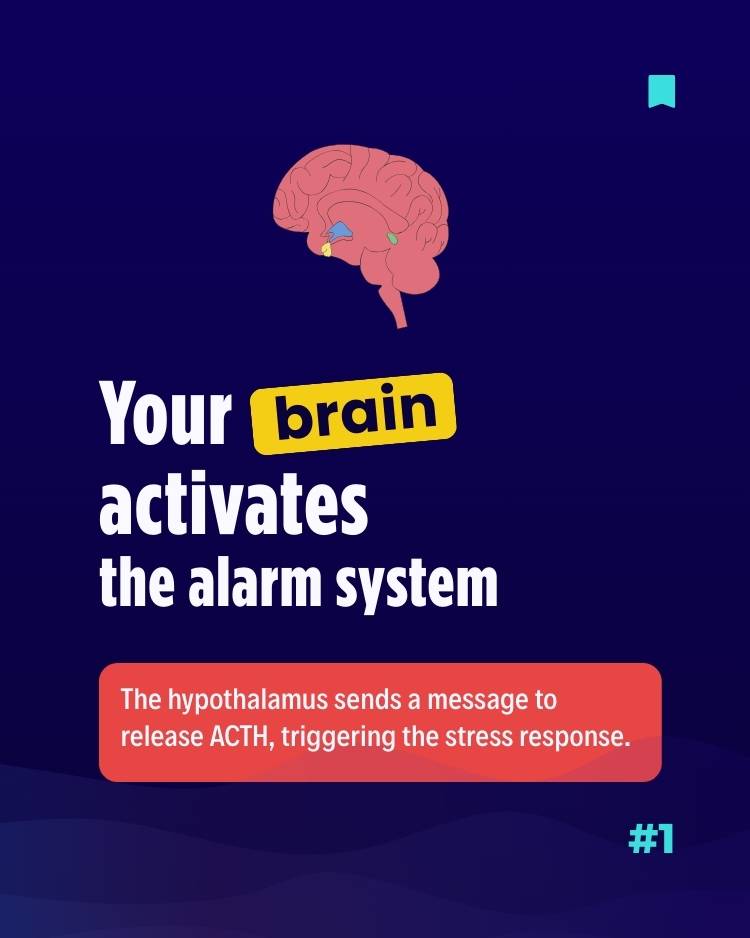
1. The brain pulls the fire alarm
The signal begins in the hypothalamus, the region responsible for detecting danger.
When it perceives a threat, physical, emotional, or even imagined, it triggers the release of ACTH (adrenocorticotropic hormone).
ACTH is the signal that tells your body, "Something might not be safe."
If you carry trauma, this detection system becomes more vigilant. Meaning your brain activates the alarm more quickly and more often, sometimes for threats that aren't actually there.
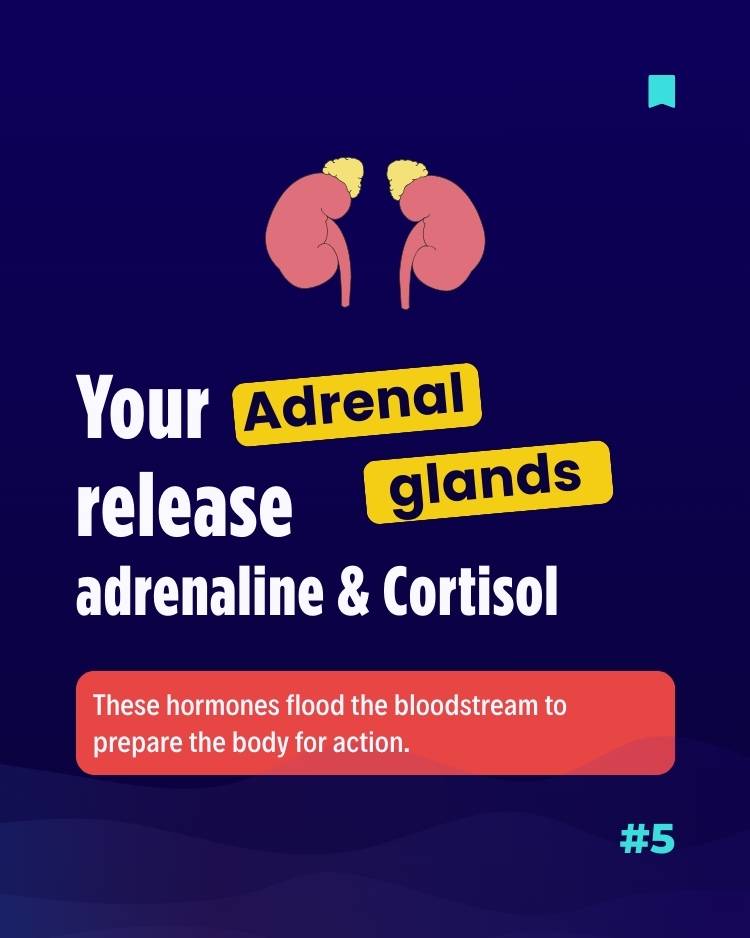
2. The adrenal glands release cortisol and adrenaline
These 2 hormones are your survival teammates.
Adrenaline mobilizes you instantly.
Cortisol keeps you alert for as long as the threat remains.
But with chronic stress or old trauma patterns, cortisol may stay elevated even after the moment is over.
That's your body trying to protect you.
This is the physiology beneath the phrase: "It's just what my body does."
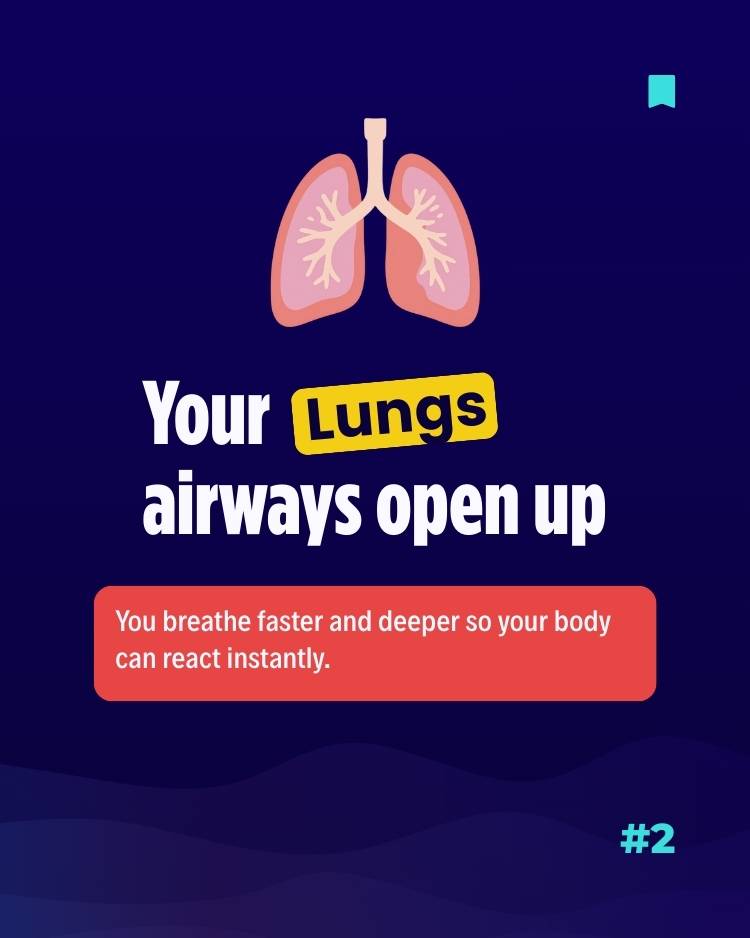
3. Your breathing changes
Your lungs open to pull in more oxygen. Breathing becomes faster or shallower.
People who have lived through trauma often develop protective breathing patterns: holding the breath, bracing, chronic shallow breathing. Their body remembers what it needed to survive.
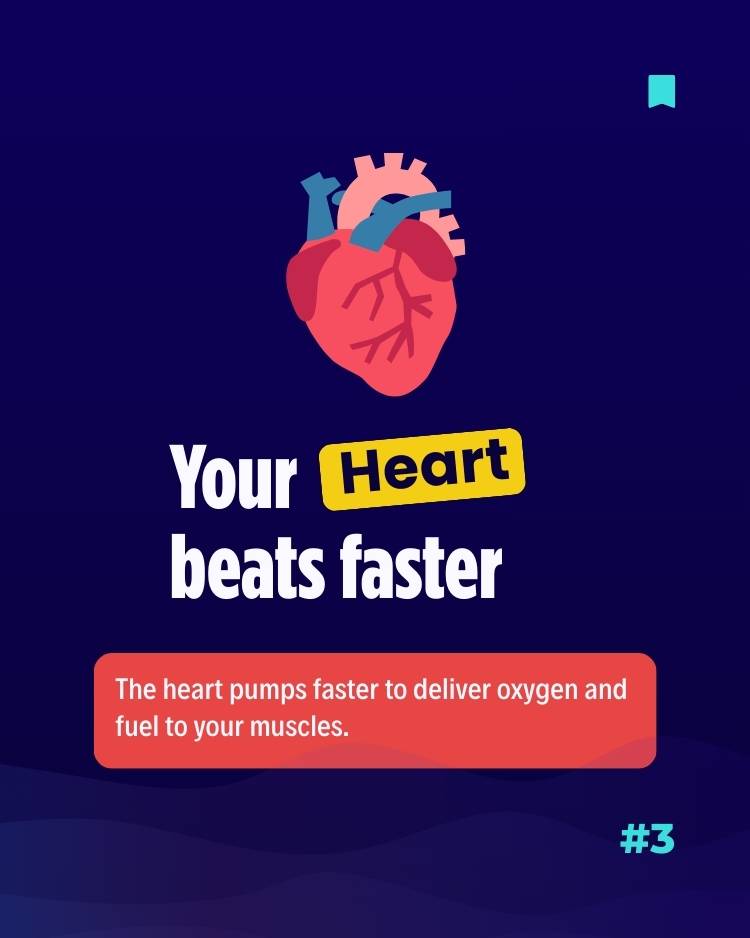
4. Your heart accelerates
Your heart pumps harder to prepare your body for action.
This can feel like:
Restlessness
Internal buzzing
Pounding heart
Difficulty relaxing even when you want to
All of this is called chronic stress physiology, not a personality trait.
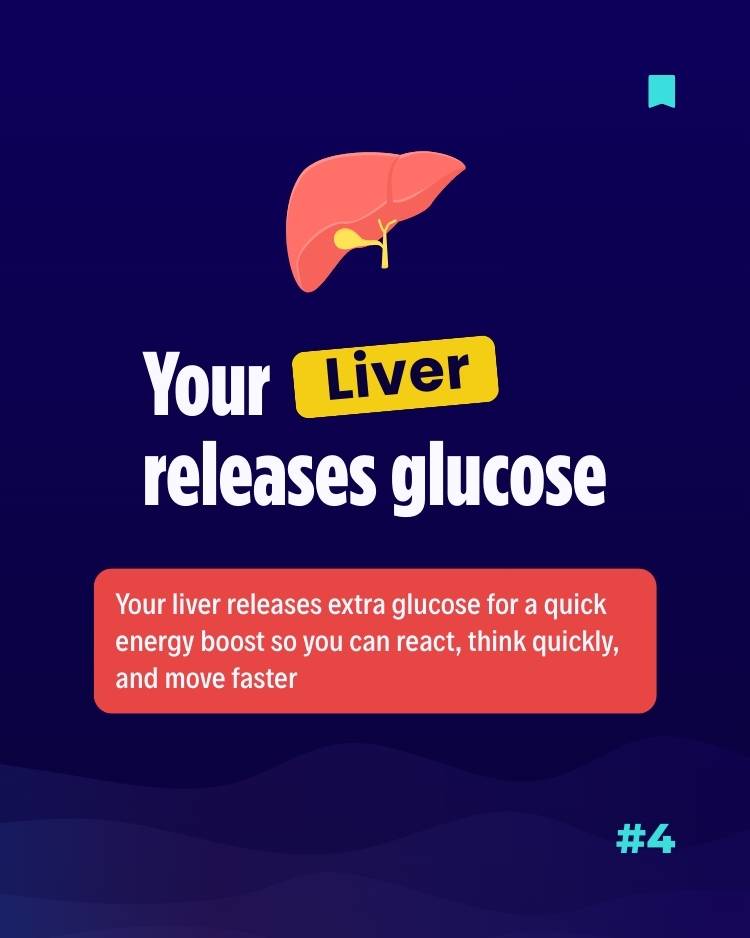
5. The liver releases glucose for immediate energy
Your system gives you quick fuel.
This is why chronic stress can affect blood sugar, hunger cues, and exhaustion cycles.
Your biology is preparing for survival.
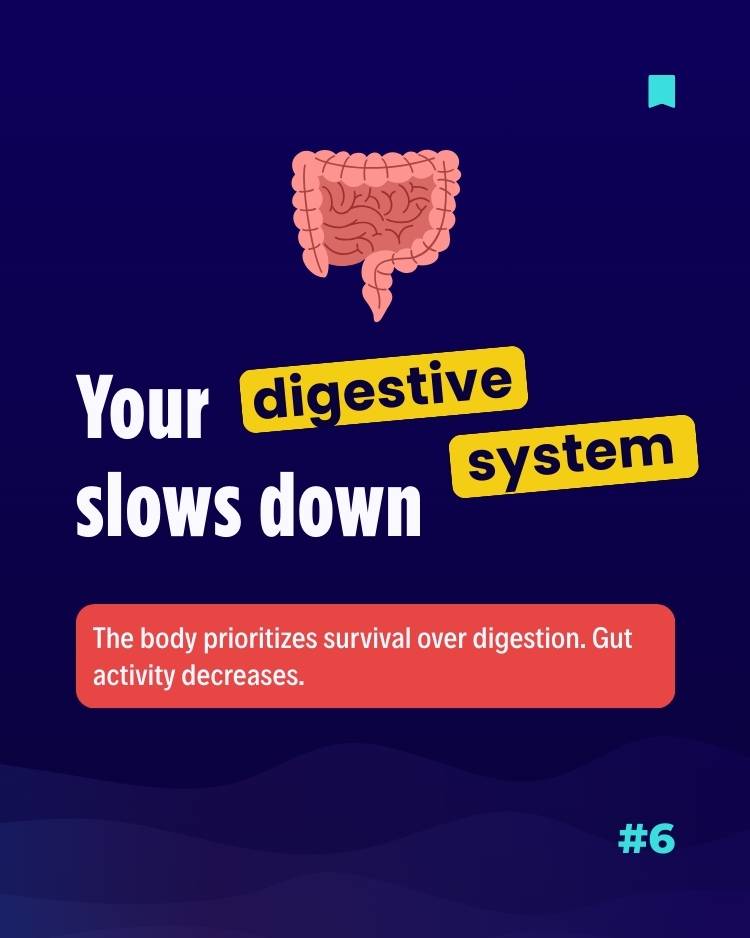
6. Digestion slows down
When your nervous system senses danger, digestion becomes non-essential. It's not a priority.
This is why stress and trauma are often directly linked with:
Bloating
Nausea
IBS-like symptoms
Appetite swings
The body is prioritizing survival over assimilation.
The lemon tart doesn't matter if your system thinks you're in danger.
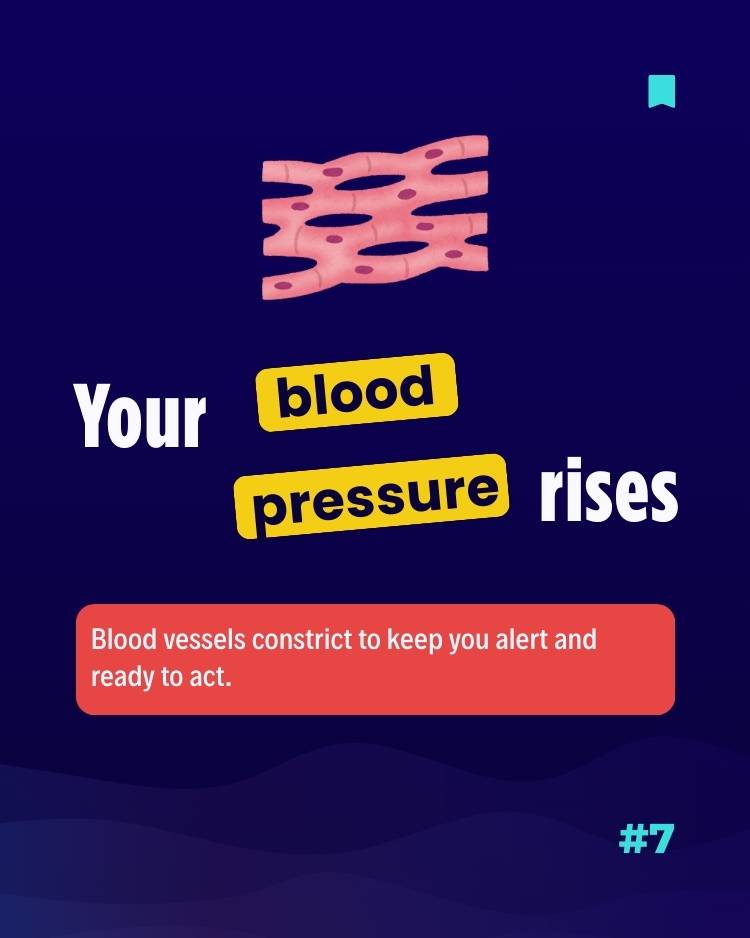
7. Blood vessels constrict
Your body increases blood pressure to heighten alertness.
Biology of stress - The brain activates the alarm systemBiology of stress - The lungs airways open upBiology of stress - The liver release glucoseBiology of stress - The digest system slows down
When stress doesn't turn off: How trauma accelerates burnout
Here is where trauma physiology and chronic stress meet.
Your stress response was meant to protect you for short bursts, not for years.
But unresolved trauma, emotional suppression, high-pressure environments, and insufficient recovery time can turn emergency mode into your default state.
This is burnout physiology:
Your system becomes unable to relax
Your brain stays alert even when you're tired
Your body interprets small stressors as major threats
Exhaustion and overwhelm begin to feel permanent
People often interpret burnout as failure.
In reality, it's a sign of loyalty—your nervous system has been protecting you nonstop.
Burnout isn't "too much stress."It's too little safety.
Your body can't tell the difference between a raised eyebrow in a meeting, an unread message, and a charging bear.
It only knows one truth: Protect. Protect. Protect.
How Trauma-informed burnout recovery begins
Your mind can't override your biology. Recovery doesn't start with thinking differently or trying harder.
Healing begins when your body receives consistent, gentle evidence that it is safe enough to downshift.
Not completely safe or regulated, just safe enough.
This evidence might look like:
Slow, grounded breathing your body can tolerate
Just enough to soften the system.
Small reductions in sensory load
Dimming lights, reducing noise, stepping away from overstimulation.
Micro-moments of safety
The warmth of a mug. A weighted blanket. A hand resting on your chest.
These moments seem tiny, but they are physiologically corrective.
Boundaries that protect your capacity
Not from a place of avoidance, but from honouring what your system can hold.
Genuine connection
Regulation is co-regulation. Healing happens in safe relationships.
Trauma-informed burnout recovery is not about forcing calm.It's about creating conditions where calm becomes possible.
Your nervous system is adaptable
And that changes everything.
Your nervous system is capable of change, its' like a muscle.
Just as trauma shapes it, healing can reshape it.
With enough repetition of safety:
Cortisol levels drop
Digestion restarts
Sleep improves
Emotional regulation returns
Cognitive clarity increases
Energy stabilizes
It happens through relationship with yourself, your body, your environment, and others.
From shame to understanding
When you understand that your body is doing what it was designed to do, you shift from:
"Why am I like this?"
to
"What is my body protecting me from?"
This question alone creates a doorway to gentleness.
What comes next
If you're curious about trauma-informed approaches to stress, or you want to rebuild your internal capacity without pushing yourself harder, I share resources and frameworks regularly on Linkedin
And if you're navigating burnout or chronic stress right now, especially if you work in a helping profession, you don't have to do this alone.
Your body is a messenger and speaks the language of protection as opposed as a failure.
Aujourd’hui je vous parle d’un sujet d’actualité qui concerne beaucoup d’entre nous : l’hypersensibilité.
Je ne vous parlerais pas ici d’hypersensibilité en général, sujet qui n’aurait pas sa place sur ce blog, et demanderait bien + qu’un seul article pour couvrir le sujet. Si cependant vous voulez en savoir plus, vous pouvez faire un tour dans l’univers de Corinne via son blog Sentiomundi, elle écrit de très beau articles.
Je vous parlerais par contre du combo hypersensibilité et entrepreneur, le combo, j’évoquerais les bénéfices que ce joli duo apportent à ma vie et mon business aujourd’hui. Et si cela résonne en vous, alors j’aurais gagné ma journée 🙂
Alors voilà…
Il était une fois, une grande hypersensible qui se lançait dans l’entreprenariat…
Le jour ou j'ai vraiment pris la décision de me lancer en tant que Freelance, après avoir traversé 8 ans de salariat, un joli burn-out et un éveil spirituel, j'étais comme paralysée, c'était comme ci tous mes sens étaient court-circuités. Je n'ai jamais eût aussi peur de ma vie.
Mais pourquoi j'ai fait çaaaaa ?
Parce que je sentais que c'était le bon moment, tout simplement. J'ai écouté mon 6ème sens qui me chuchotait à l'oreil depuis toujours que mon avenir était là, que c'était ça, tout simplement.
J'avais peur mais je l'ai fait, parce que quand t'es hypersensible tu as juste pas le choix d'écouter ton instinct, sinon tous tes sens se mettent en éveil pour te forcer à t'aligner, ton corps te parle puisque tu ne veux pas écouter ta petite voix. C'est une excellente boussole de vie. Alors j'ai écouté cette petite voix qui me disait...
L'esprit c'est comme un parachute, pour que ça marche il faut l'ouvrir
Et j'ai sauté ! Bim Bam Boum ça m'a secoué en plein vol, c'est comme la sensation de passer dans un mixer (Où d'être dans la pub orangina). Jusqu'à ce que le parachûte s'ouvre, et que d'un coup tu ouvre enfin grand les yeux (après les avoir fermés pendant top longtemps). Alors tu prends conscience de la grandeur de ce monde, et du rôle d'acteur que tu as à y jouer. Tout est calme et ton esprit s'apaise, car tu as pris le bon chemin, et une fois les pieds sur terre...
L’empathie & l’intuition pour percevoir les besoins des clients
Alors au début j'ai papillonée, j'ai travaillé pour des connaissances, certains amis, puis j'ai fait ce que je savais bien faire, être moi et continuer à percevoir et être clairevoyante dans mon travail, avec cette idée en tête de vouloir trouver un sens à ce que je faisais, en aidant mes clients à prendre conscience du diamant brut qu'ils étaient, et les faire briller grâce à mes expértises marketing.
L’empathie et la sensibilité émotionnelle des hypersensibles permettent de capter immédiatement les états émotionnels et besoins des personnes avec qui on communique, et j'ai réalisé qu'elle était là, ma force !
Avant je me souviens que lorsque j’arrivais au bureau le matin, je captais automatiquement les humeurs, je ressentais les tensions managériales, parfois devinais les problématiques. J’étais déstabilisé par cette sensation de « savoir » ce que tout le monde ressentait, en bien ou en mal, ça me rendait souvent mal à l’aise, je me sentais parano.
Aujourd’hui j’ai appris à écouter cette clairvoyance l’accepter, et surtout l'exploiter ! Ce qui me permet de ressentir mes clients, et de pouvoir immédiatement capter le feeling qui se dégage de nos conversations pour le mettre en lumière sur la toile. Je me sers de cette empathie et cette intuition comme alliés dans ma vie de freelance. Et quel kiff absolu !
Le calme comme environnement de travail
Flashback : Dans mon dernier emploi en tant que salarié, on était 4 en open Space, on était une super team, mais j’étais placé dos à la porte d’entrée qui claquait à longueur de journée et le téléphone sonnait environ 10 fois par heure.
Me concentrer sur mes tâches relevait alors du challenge, le moindre bruit me sortait de ma bulle, et ne pas voir la porte me donnait constamment envie de me retourner, ce qui ramenait ma productivité au joli chiffre 0 bien souvent.
Il y aussi le truc que chaque nouvelle rencontre ou événement me remplissait d’émotions. Même dans ma vie perso, j’ai toujours besoin d’un temps de retrait pour laisser évacuer toutes les énergies accumulées, et c'était ultra dur de devoir gérer ça en entreprise.
Depuis que je suis Freelance je peux travailler au calme et me réfugier dans mon cocon en gérant ma concentration. Je test souvent de nouvelles techniques de productivité et je prends des pauses au besoin et n'oublie pas mes petits rituels quotidiens salvateurs (Méditer, marcher, lire…).
Puis si je ne me sens pas, je m'écoute, tout simplement, car me forcer ne m'aménera à rien.
La liberté comme Leitmotiv
Le sentiment de liberté que procure le fait de travailler en Freelance n’a pas de prix. Et je crois que la liberté est une des valeurs communes des hypersensibles : Etre libre de s’exprimer, s’éparpiller, perfectionner, déconstruire pour reconstruire, avoir 1000 idées à la seconde, n’en réaliser vraiment que 2 (C'est déjà d'ailleurs super bien)
Je crois que toute entrepreneuse hypersensible sera d’accord avec ça, c’est ESSENTIEL pour nous, c’est ce qui nous fait vibrer, être LIBRE
Bosser pour soi permet de développer les choses à sa manière, avec sa propre vision, et ses propres messages, tout en écoutant les besoins des autres, c’est un des trucs les plus génial quand on est Freelance.
« Déployer ses ailes et s’envoler vers la liberté »
Etre Freelance me permet aujourd’hui d’être fière de mon hypersensibilité autrefois douloureuse. Je l’ai transformé en pouvoir de power ranger, qui me permet d’exprimer mon plein potentiel et casser des murs de glace tous les jours.
Je crois que l’entreprenariat est une sorte de thérapie, je me sens réapprendre la vie chaque jour et il était pour moi important de vous partager l’évolution de mes sensations depuis que je me suis lancée dans cette aventure.
J’ajouterais que la créativité, le besoin de liberté, l'empathie et la sensibilité émotionnelle qui se dégage de nous, hypersensibles, révèlent une humanité hors du commun, souvent révélatrice d’une envie profonde de vouloir changer le monde.
Certains nous prennent pour des bisounours, d’autres admirent notre audace.
Alors si cet article t’aide, te conforte dans tes idées, ou te donne le courage de te lancer, fonce, va-y ! C’est une aventure hors du commun ! Nous sommes déjà beaucoup à avoir mis le pied à l’étrier pour construire un monde meilleur, qui nous correspond, et ça n’est que le début 😉
Lorsqu’on se lance dans la création d’un site internet, l’un des premier pas qui accompagne la sélection de l'hébergeur et de votre outil CMS est le choix de votre nom de domaine. Et oui, on a tendance à le sous estimez celui-ci, mais si on ne prend pas bien en compte quelques détails importants, ça peut vite devenir une prise de tête !
Mais avant de vous jeter sur votre boîte de paracétamol, je vous tiens à vous rassurer car si vous suivez bien les conseils que je vais vous partager ici, vous verrez que ça n’est pas si sorcier.
Avant toutes choses, je voudrais juste vous rappeler pourquoi il est important de ne pas négliger cette étape dans votre démarche de création. Vous voyez, c’est un peu comme le choix du prénom de votre premier enfant, vous ne pouvez pas vous rater. C’est un peu ce qui va le suivre toute sa vie, depuis le bac à sable jusqu’à son envol professionnel en passant son premier coup de coeur amoureux (Oui, moi aussi je t’aime “Bobby L’Ourson”! On est d’accord, ça le fait moyen…). Bref, d’une c’est ce qui va refléter votre personnalité et/ou celle de votre business, et en plus c’est ce qui va vous rendre visible sur internet par les différents algorithmes. Alors, prêt à faire swinguer un peu vos méninges ?
1 - Brainstormez vos idées
C’est très rare que le premier nom que l’on ait en tête soit le grand gagnant. Il est toujours intéressant de comparer ces différentes idées afin de trouver LE nom qui sera le plus adapté à votre personnalité et aux règles du web.
Comment s’y prendre? Mettre en place une ou plusieurs session de brainstorming. Si vous n’avez jamais entendu parlé de ce mot que l’on pourrait traduire par “remu-méninges” (on s’accordera sur le faire que la version anglaise est un peu plus glamour), il s’agit d’émettre librement et spontanément des idées ou suggestions en relation avec le sujet que l’on souhaite traiter. Et oui, c’est aussi simple que ça. C’est une méthode très efficace que l’on utilise beaucoup plus souvent que l’on ne le pense au quotidien. Par exemple, quand vous ne savez pas quoi cuisiner le soir, pour décider du film à aller voir, etc. On ouvre un champ des possibles devant nous pour prendre la décision qui satisfera l’ensemble des personnes concernées.
Pour le choix de votre nom de domaine, je vous encourage de tout mettre sur papier.
Prenez un crayon et une feuille blanche et commencer à noter tout ce qui vous vient, sans jugement.
Même si quelque chose vous vient qui vous parait un peu farfelue, notez-le, cela pourra vous servir dans votre décision final.
Une fois que vous avez noté toutes vos idées (idéalement, vous devriez en avoir un minimum de 15), je vous invite à les partager avec plusieurs personnes de votre entourage qui acceptent de vous aider dans votre quête. Après leur avoir clairement expliqué votre projet, demandez-leur ce qu’ils pensent de chacune des idées proposées, et écrivez les suggestions qu’ils pourraient avoir. Terminez en sélectionnant 3 ou 4 des idées validées ensemble.
C’est bon? Alors, je vous invite à passer à l’étape suivante pour voir lequel de ces noms est le plus intéressant stratégiquement parlant.
2 - Adaptez votre choix aux règles
Pour un nom de domaine efficace, il faudrait le choisir en respectant certaines règles :
Court et efficace
Comme pour un nom de marque, le nom de votre site doit être facile à retenir pour tout le monde. Plus il sera court et incisif, plus il sera efficace; le nombre de caractères maximum accepté étant de 63.
Veillez également à ce qu’il soit représentatif de votre marque et du contenu de votre site, et facile à prononcer et à retenir. Ce sera encore fois plus facile pour les personnes de vous trouver si elles vous ont connu via un autre réseau.
Le Saviez-vous?
« wiemenschlichmenschensindzeigtihrumgangmitdermuttersprachefrsch » est le nom de domaine le plus long du monde (moi non plus j'arrive pas à le dire), il est l’œuvre d’un institut allemand qui a réservé ce nom de domaine pour célébrer le 200ème anniversaire de la mort de l’auteur allemand Friedrich Schiller..
Evitez les chiffres et les tirets
A moins que le chiffre soit en connection direct avec votre nom de marque (ex: https://www.century21.fr), on conseille de les éviter pour une raison de référencement, et encore une fois pour qu’il soit plus facilement retenu par votre audience. Il faut d’ailleurs savoir que Google inflige des pénalités aux noms de domaine qui comportent trop de tirets (Pas toujours commode ce Google).
Si toutefois vous possédez des noms de domaines en plusieurs mots, les versions avec tirets peuvent être utile pour faciliter la lecture (pas plus de 2), ou pour vous protéger de la concurrence. Cela peut être une bonne stratégie pour vous mettre à l’abri d’éventuelles tentatives d’usurpation de votre marque. Vous pouvez par exemple acheter plusieurs options de nom de domaine avec ou sans tiret, pour en être l’unique et seul propriétaire.
Mot-clé ou un nom de marque ?
La problématique courante consiste à se demander s’il n’est pas plus judicieux d'opter pour un nom de domaine possédant des mots-clés, le nom d'une marque ou les 2.
Concrètement, les mots clés présents dans le nom de domaine sont utilisés, par les moteurs de recherche, pour classer les résultats par pertinence(critère peu utilisé pour le référencement sur Google mais important pour Bing)
Aussi, le fait que des sites fassent des liens en utilisant le nom de domaine permettront d’obtenir indirectement un bon positionnement des les résultats présents dans les moteurs de recherche. Et bien sûr, lorsque le visiteur verra le nom du site, il comprendra tout de suite la thématique sans même avoir besoin d'avoir une explication. Et c’est ce qu’on recherche mon cher Watson !
3 - Vérifiez la disponibilité
Une fois que votre choix se précise, rendez-vous sur un site permettant de vérifier la disponibilité de ce nom (et oui, autre petit détail auquel il faut penser en amont afin d’éviter toute deception), tel que chez OVH.
Ce nom de domaine est déjà pris?
Si vous voyez que l’un des noms de domaine sur lesquels vous vous étiez arrêté est déjà pris, il va falloir penser à un plan B. Commencez par vous poser ces questions?
Mon nom de domaine ressemble t-il trop à une marque ou un blog déjà existant?
Parmis les idées ressorties du brainstorming, il y a t-il un autre nom qui me plait que je pourrais utiliser à la place et libre de droit?
Attention! Si votre nom de domaine ressemble trop à celui d’une marque déposée vous prenez le risque d’avoir des problèmes juridiques, voire de ruiner votre réputation pour “plagia”.
Vous y êtes presque, encore un petit effort et vous aurez enfin LE nom de domaine de votre site !
4 - Choisissez l’extension
Dernière étape dans la définition du nom de domaine de votre site, le choix de l’extension. Les plus classiques, en plus des .com et .fr, étant :
.info - Si vous faites un blog d’information par exemple
.org - Particulièrement pour un organisme à but non lucratif ou une association)
.biz - Pour un business, une entreprise, un site de e-commerce…
.me - Certains l’utilisent pour leurs blogs mais c’est souvent mieux pour une page professionnelle à votre nom, avec un CV ou un portfolio en ligne par exemple.
Bien qu’il n’existe pas de règle à proprement parlé ici, on donnera tout de même un avantage à l’utilisation du .com pour son attrait plus “universel”.
Dans tous les cas, adaptez-le à votre cible et votre position géographique. Si vous vous adressez au marché français, vous conviendrez donc qu’il est plus judicieux d’enregistrer votre nom sous un .fr .
Encore une fois, gardez en tête plusieurs option au niveau stratégique et n’hésitez pas un investir dans plusieurs nom de domaines “annexes” pour en préserver les droits et éviter de laisser le champ libre à la concurrence.
Astuce: Si vous avez optez pour une adresse principale “mondomaine.com”, achetez également l’option “mondomaine.fr” ou “mon-domaine.com” si toute ou partie de votre cible se trouve sur le marché français, et redirigez-le vers votre nom principal.
Et voilà! Vous avez enfin trouvé le nom de domaine qui colle à votre identité et marque, et qui sera facilement mémorisable par votre audience pour vous retrouver facilement.
Dernier petit conseil pour ceux pour qui malgré tous ces efforts n’ont pas trouvé de nom disponible, n’hésitez pas à revenir sur vos notes de brainstorming. Vous y trouverez peut-être une idée géniale que vous aviez mis de côté et qui pourrait pourtant remporter le premier prix! 😉
Pour résumer les étapes :
Brainstormez vos idées : notez toutes vos idées et gardez les 3 meilleures
Adaptez votre choix aux règles pour un nom de domaine court & efficace, sans chiffres & sans ou 2 tirets max, avec votre mot clé si possible.
A vous de jouer maintenant! N’hésitez pas à me partager vos trouvailles en commentaire, je vous ferais un retour 🙂
Hello ! Moi c'est Laura
Je suis Webmarketer et ma mission est d'aider les entrepreneurs du changement à se construire une image qui leur ressemble sur le web et communiquer leurs messages au monde. Ici je vous partage des infos sur le web en général, DIVI, mon thème Wordpress de prédilection, et la vie de freelance & digital nomade. Bonne lecture :)









 Je suis Webmarketer et ma mission est d'aider les entrepreneurs du changement à se construire une image qui leur ressemble sur le web et communiquer leurs messages au monde. Ici je vous partage des infos sur le web en général, DIVI, mon thème Wordpress de prédilection, et la vie de freelance & digital nomade. Bonne lecture :)